NASA ASTRONAUT PERFORMS PH STUDENTS’ EXPERIMENT IN SPACE
AN EXPERIMENT designed by Filipino students was “successfully conducted” onboard the Kibo module of the International Space Station (ISS) last March 24, the Philippine Space Agency (PhilSA) announced Friday.
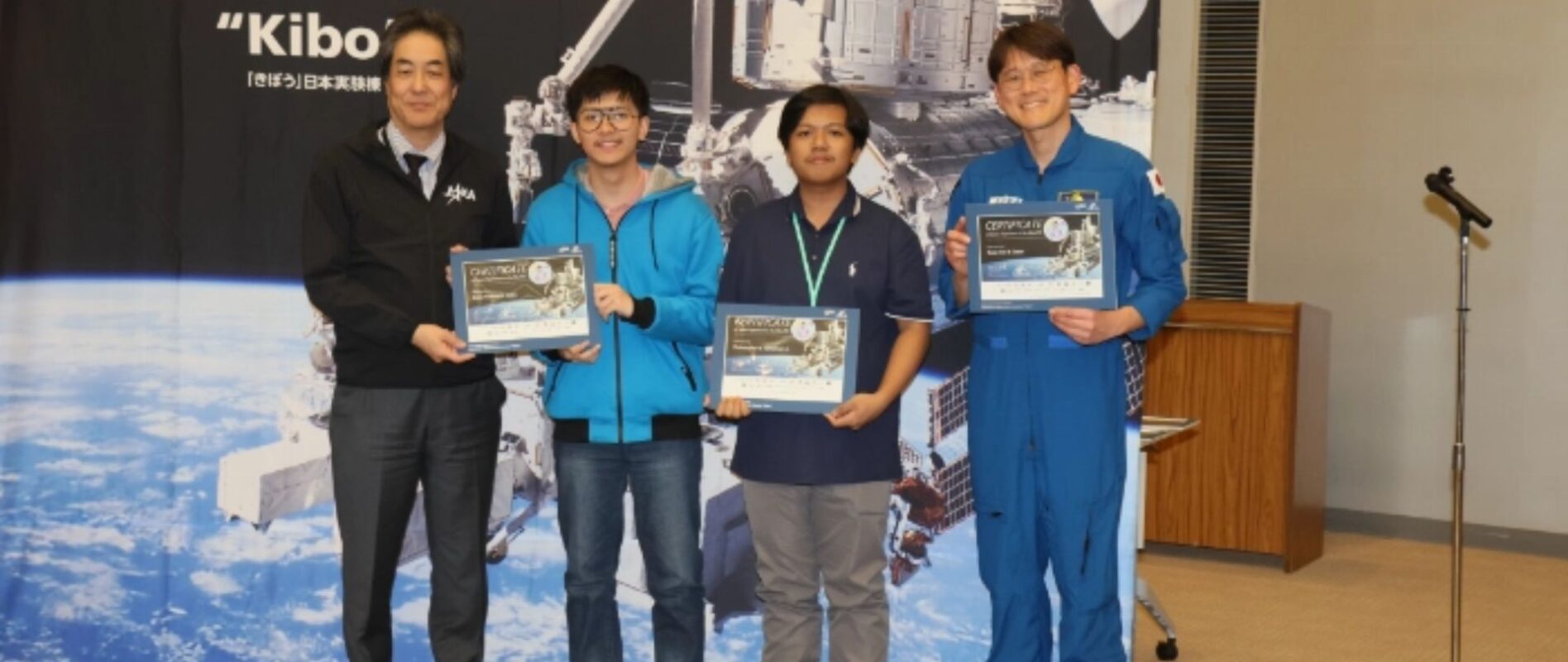
The Double Gyroscope experiment designed by third-year students Christopher Tumamac, Ryan Andrew Doña, and Rose Ann Cezar, all Physics major at Rizal Technological University (RTU), was performed by National Aeronautics and Space Administration (NASA) Astronaut Christopher Williams, the PhilSA said in a news release.
Doña and Tumamac presented their experiment proposal at the Japan Aerospace Exploration Agency (JAXA) Tsukuba Space Center in Ibaraki, Japan, before the live execution of their experiment.
Williams conducted 11 experiments, including 10 from other countries, on the ISS while being livestreamed.
The 11 experiments were finalists of JAXA’s ATZG (Asian Try Zero-G) competition, which invites students and young scientists from the Asia-Pacific region to design simple physics experiments that can be performed in zero gravity.
PhilSA said the RTU students shared that conducting experiments in a zero-gravity environment presents unique challenges and opportunities, as weightlessness can affect how objects move despite careful planning.
Double Gyroscope demonstrates a key principle used in spacecraft orientation, or how satellites and spacecraft control the direction they face in space.
This experiment focused on two gyroscopes, or spinning devices used to help measure or maintain direction and balance, placed at the end of a stick.
“The (RTU) students hypothesized that when the gyroscopes spin in opposite directions, their motion may cancel each other out, causing the system to appear stable or nearly motionless. However, small differences in spinning could slowly change the direction the device points to over time,” PhilSA said.
To observe the movement in zero gravity, Williams repeatedly conducted tests by spinning the gyroscopes and observing their movements closely.
Meanwhile, the Philippines has participated in the competition through the PhilSA, which serves as the local organizer as part of its education and outreach initiatives.
Since 2022, experiments from Filipino students “have consistently been selected as ATZG finalists and carried out on the ISS by astronauts,” the agency said. (PNA)